



How Does an HVAC System Work?
Most homeowners in Bucks, Montgomery, Chester, and Delaware County interact with their HVAC system daily, but few know what’s happening inside the equipment.
At Hirschberg Mechanical, we’ve been explaining how heating and cooling systems work to homeowners across southeastern Pennsylvania since 1983. When you understand your system, you make better decisions and catch problems before they become expensive ones.
TL;DR
Your HVAC system moves heat rather than creating it. In winter, it generates and distributes warmth. In summer, it pulls heat out of your indoor air and sends it outside. A blower motor, refrigerant cycle, and duct system work together to deliver conditioned air throughout your home. Understanding how this process works helps you recognize when something is wrong.
Key Takeaways
- The refrigerant cycle is what makes air conditioning possible
- Your furnace and AC work together through the same air handler and duct system
- HVAC airflow depends on your blower motor, filter, and ductwork functioning correctly
- Most comfort problems trace back to one failing component in the chain
HVAC System Parts and Functions: It Starts with the Thermostat
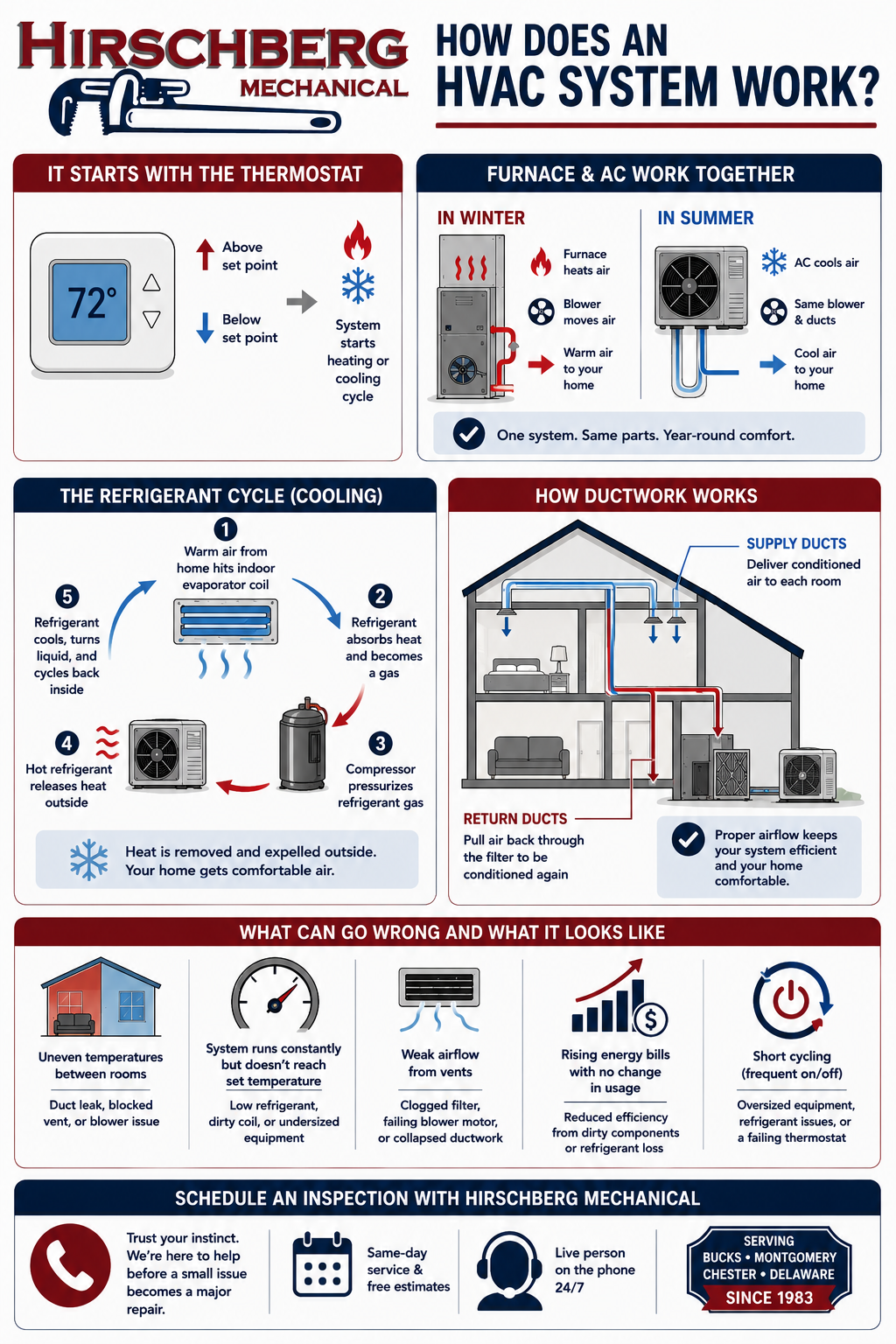
When indoor temperature rises above or drops below your set point, your thermostat sends a signal to your system to start a heating or cooling cycle. A miscalibrated thermostat, or one placed near a heat source like a sunny window, can cause your system to run unnecessarily or shut off too soon.
How Does a Furnace and AC Work Together?
Your furnace and air conditioner are separate pieces of equipment, but they share the same infrastructure. Both rely on the same air handler, blower motor, and duct system to deliver conditioned air.
In winter, your furnace burns fuel to heat a metal heat exchanger. The blower motor pulls return air from your living spaces, passes it across the heat exchanger, and pushes the warmed air through your duct system and out through supply vents in each room.
In summer, the furnace sits idle. The air conditioner takes over, using the same blower and ducts to circulate cooled air. This is why a problem with your air handler or blower motor affects both heating and cooling.
How Does Central Air Work? The Refrigerant Cycle Explained
The HVAC refrigerant cycle is what makes cooling possible. Here’s how it works in plain terms:
- Warm return air from your home passes over the indoor evaporator coil
- Refrigerant inside the coil absorbs that heat and evaporates into a gas
- The compressor in the outdoor unit pressurizes the refrigerant gas
- The hot refrigerant moves to the outdoor condenser coil, where a fan blows outside air across it
- The refrigerant cools, returns to liquid form, and cycles back inside to absorb more heat
Your home doesn’t get “filled with cold air.” The heat is physically removed and expelled outside. The air that returns through your vents is simply air that’s had its heat extracted.
How Does Ductwork Work?
Your ducts are the delivery system. Supply ducts carry conditioned air from the air handler to each room. Return ducts pull air back from your living spaces, through the filter, and into the system to be conditioned again.
HVAC airflow depends on this loop functioning properly. Leaky supply ducts lose conditioned air before it reaches the room. Blocked or undersized return ducts starve the system of air, causing the blower to strain and indoor pressure to become unbalanced.
What Can Go Wrong and What It Looks Like
Knowing how home heating and cooling systems work makes warning signs easier to recognize:
- Uneven temperatures between rooms — often a duct leak, blocked vent, or blower issue
- System runs constantly but doesn’t reach the set temperature — low refrigerant, dirty coil, or undersized equipment
- Weak airflow from vents — clogged filter, failing blower motor, or collapsed ductwork
- Rising energy bills with no change in usage — reduced efficiency from dirty components or refrigerant loss
- Short cycling (frequent on/off) — oversized equipment, refrigerant issues, or a failing thermostat
FAQs
Why does my house have hot and cold spots even when the system is running?
Uneven temperatures are almost always a distribution problem. Leaky or improperly balanced ductwork, blocked vents, or a blower motor running below the correct speed are the most common causes we find during inspections in southeastern Pennsylvania.
How do I know if my refrigerant is low?
Signs include warm air from supply vents, ice forming on the evaporator coil or refrigerant lines, and a system that runs without reaching your set temperature.
Does closing vents in unused rooms save energy?
No, and it can actually cause damage. Closing vents increases static pressure in your duct system, which forces the blower motor to work harder and can cause the evaporator coil to freeze. Always leave them open.
How often should my HVAC system cycle on and off?
A properly sized system typically runs two to three cycles per hour, each lasting 10 to 15 minutes. Short, frequent cycling usually points to oversized equipment or a thermostat problem. Continuous cycles without reaching the set temperature suggest a maintenance issue.
Schedule an Inspection with Hirschberg Mechanical
If something about the way your system sounds, feels, or performs doesn’t seem right, trust that instinct.
Hirschberg Mechanical has been diagnosing and repairing HVAC systems throughout Bucks, Montgomery, Chester, and Delaware County since 1983. We offer same-day service, free estimates, and a live person on the phone 24/7. Call us before a small issue becomes a major repair.