



The Complete Guide to Home Comfort Systems: HVAC Explained
If your home feels too hot in July and too cold in January, you may not have a comfort problem. You have an HVAC problem.
At Hirschberg Mechanical, we’ve been helping homeowners and businesses across Bucks, Montgomery, Chester, and Delaware County understand and maintain their home comfort systems since 1983. During that time, one thing has stayed consistent: most people don’t know how a heating and cooling system for homes works until something goes wrong.
TL;DR
An HVAC system controls your home’s temperature, air quality, and humidity. It consists of several components that work together to keep your home comfortable year-round. Understanding how your residential HVAC system works helps you catch problems early, extend equipment life, and make smarter decisions when it’s time to repair or replace.
Key Takeaways
- HVAC stands for heating, ventilation, and air conditioning
- The main components are the furnace or heat pump, air conditioner, air handler, ductwork, and thermostat
- There are several types of HVAC systems
- Pennsylvania’s four-season climate puts significant seasonal demand on residential systems
What Is an HVAC System?
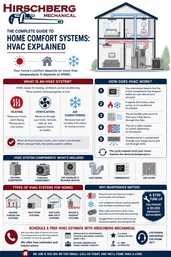
HVAC stands for heating, ventilation, and air conditioning. It’s the collective term for the equipment, ductwork, and controls that regulate your home’s temperature, humidity, and air quality throughout the year. Think of it as three systems working together as one.
- Heating — Keeps your home warm during Pennsylvania’s cold winters
- Ventilation — Moves air through your home, removes stale air, and supports indoor air quality
- Air Conditioning — Removes heat and humidity from indoor air during summer
When all three functions work, your home is comfortable. When one part fails, the entire system suffers.
How Does HVAC Work?
Understanding how an HVAC works starts with one core principle: your system doesn’t create hot or cold air. It moves heat.
In winter, your furnace or heat pump generates heat and distributes it through your ductwork into each room of your home. In summer, your air conditioner pulls heat out of your indoor air and releases it outside, leaving cooler air behind. Ventilation handles the continuous exchange of air to keep things fresh and balanced.
Here’s the basic cycle on a typical central HVAC system:
- Your thermostat detects that the indoor temperature has dropped below (or risen above) your set point
- It signals the furnace, heat pump, or air conditioner to activate
- The air handler pulls return air from your living spaces through the filter
- That air is either heated or cooled, depending on the season
- Conditioned air is pushed back through your supply ducts and out through vents
- The cycle repeats until your home reaches the desired temperature
The team at Hirschberg Mechanical has walked through this process in thousands of homes across southeastern Pennsylvania. Once homeowners understand the cycle, they immediately start noticing things like weak airflow from a vent, a room that never quite reaches temperature, or a system that runs too long without shutting off.
HVAC System Components: What’s Included
A residential HVAC system contains several individual components. Each one has a specific job. When one underperforms, the others are forced to compensate.
- The heating component
- The cooling component
- The air handler and blower motor
- The ductwork
- The thermostat
- The air filter
Types of HVAC Systems for Residential Homes
Not every home comfort system is built the same way. During the decades we’ve been serving Willow Grove and the surrounding communities, we’ve worked on every configuration you can imagine. Here’s a practical HVAC system overview of the most common types:
- Central forced-air systems
- Heat pump systems
- Ductless mini-split systems
- Boiler and radiant systems
Why Residential HVAC Maintenance Isn’t Optional
Pennsylvania weather is not gentle on HVAC equipment. Our winters are cold enough to push furnaces and heat pumps to their limits. Our summers are humid enough to tax air conditioning systems for months at a time. Meanwhile, fall and spring bring rapid temperature swings that force systems to alternate between heating and cooling within the same week.
In our experience, the home comfort systems that fail prematurely almost always share one thing in common: they were not maintained consistently.
Annual tune-ups accomplish more than most homeowners realize:
- Dirty burners and heat exchangers work harder and fail faster
- Low refrigerant reduces cooling capacity and increases compressor wear
- Worn belts and motors draw more electricity and eventually stop working
- Clogged filters restrict airflow across the entire system, shortening its life
We always tell our customers that a $150 tune-up can prevent a $5,000 emergency replacement.

FAQs
How long does a residential HVAC system last?
Most furnaces last 15 to 20 years with maintenance, central air conditioners last 12 to 17 years, and heat pumps typically fall in the 15-year range. Neglected systems often fail before those benchmarks. Hirschberg Mechanical offers a 10-year warranty on new equipment and a 1-year service warranty, so you’re covered long after the installation is complete.
How do I know if my home comfort system is the right size?
An undersized system runs constantly and still can’t keep up. An oversized system short-cycles, which causes humidity problems and wears out components faster. Proper sizing requires a load calculation based on your home’s square footage, insulation, window placement, and orientation. We perform this assessment as part of our free estimate process before recommending new equipment.
What’s the difference between a heat pump and a furnace?
A furnace generates heat by burning fuel. A heat pump transfers warmth from the outdoor air into your home in winter and reverses that process in summer. Heat pumps are more efficient in moderate temperatures. In southeastern Pennsylvania, where winter lows can dip well below freezing, a dual-fuel system that pairs a heat pump with a gas furnace gives you efficiency when temperatures allow and raw heating power when you need it most.
When should I repair vs. replace my HVAC system?
If the repair cost exceeds 50 percent of the cost of a new system, and your equipment is more than 10 years old, replacement is usually the smarter investment. That said, it depends on the specific failure, the condition of the system, and your goals. We don’t push unnecessary replacements. Instead, we give you honest information and let you decide.
Schedule a Free HVAC Estimate with Hirschberg Mechanical
If you’re not sure what type of system you have, if your equipment is performing properly, or whether it’s time to upgrade, we offer free estimates and helpful advice.
Hirschberg Mechanical has been serving homeowners and businesses across Bucks, Montgomery, Chester, and Delaware County since 1983. We’re a second-generation, family-owned company with a 4.9-star Google rating, an A+ BBB accreditation, and a live person answering the phone 24 hours a day, 7 days a week.
No job is too big or too small. Call us today, and we’ll come take a look.